
B-25 "Show Me" Missouri Wing
Description:
Base:
St. Charles County Smart Airport, St. Charles, MO
Website:
| B-25 Specs | |
|---|---|
| Role | Medium Bomber |
| Manufacturer | North American Aviation |
| Introduced | 1941 |
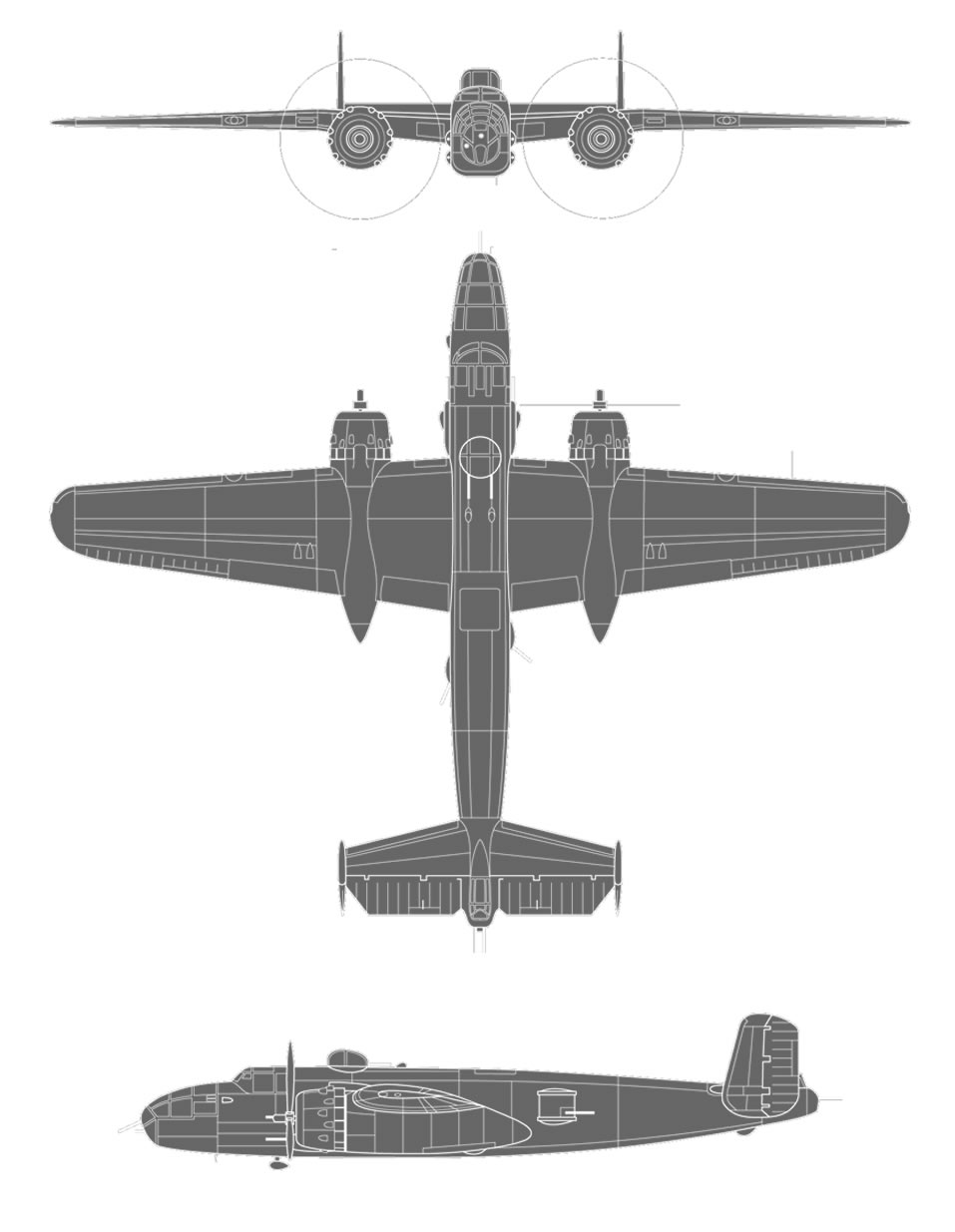
| Power | 2 × Wright R-2600-35 Twin Cyclone 14-cylinder air-cooled radial engine, 1,700 hp each |
| Length | 52 ft 11 in |
| Height | 16 ft 4 in |
| Wingspan | 67 ft 7 in |
| Range | 1,350 mi |
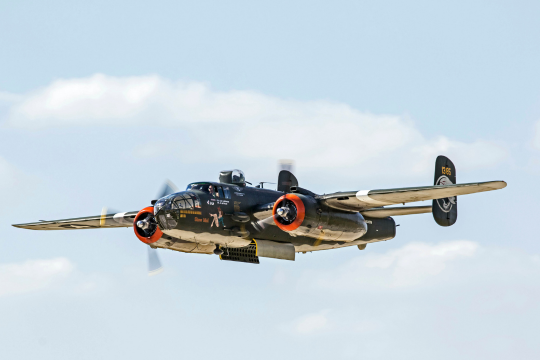
Delivered to the USAAF as 44-31385 in January of 1945, our B-25J stayed in service as a trainer up until it was retired and put into storage at Davis Monthan AFB, AZ in 1958.
In 1959, 44-31385 (being assigned to the Aircraft Disposal Office) was sold to its first private owner officially changing its call sign to N3481G.
During 1969 in Seymour, IL the bomber was damaged on the ground by a windstorm and did not fly again until 1975.
It found its home with the Missouri Wing of the Commemorative Air Force in 1982 and was officially renamed "Show Me" with a civil registration of N345TH.
Thus began its life as a living history aircraft and one of the few elite bombers of the Ghost Squadron.
The North American B-25 Mitchell was among the most versatile bombers of World War II. Built by North American Aviation and named for airpower pioneer William "Billy" Mitchell, the twin-engine aircraft served in every theater of the War.
The B-25 became famous for its role in the Doolittle Raid, but its impact went far beyond that mission. U.S. and Allied forces used it for bombing, strafing, reconnaissance, and patrol missions around the world. Nearly 10,000 were built, and many continued flying for decades after the war—earning the Mitchell a lasting place in aviation history.
Adaptable and rugged, the Mitchell evolved into numerous variants throughout the war, including heavily armed gunships and reconnaissance models. U.S. Marine Corps versions, known as PBJ-1s, operated from island bases across the Pacific. Whether striking shipping at low level or supporting ground troops, the B-25 proved it could do just about anything asked of it—and do it well.