AT-6 Ace in the Hole Houston Wing
Description:
Base:
West Houston Airport, Houston, TX
Website:
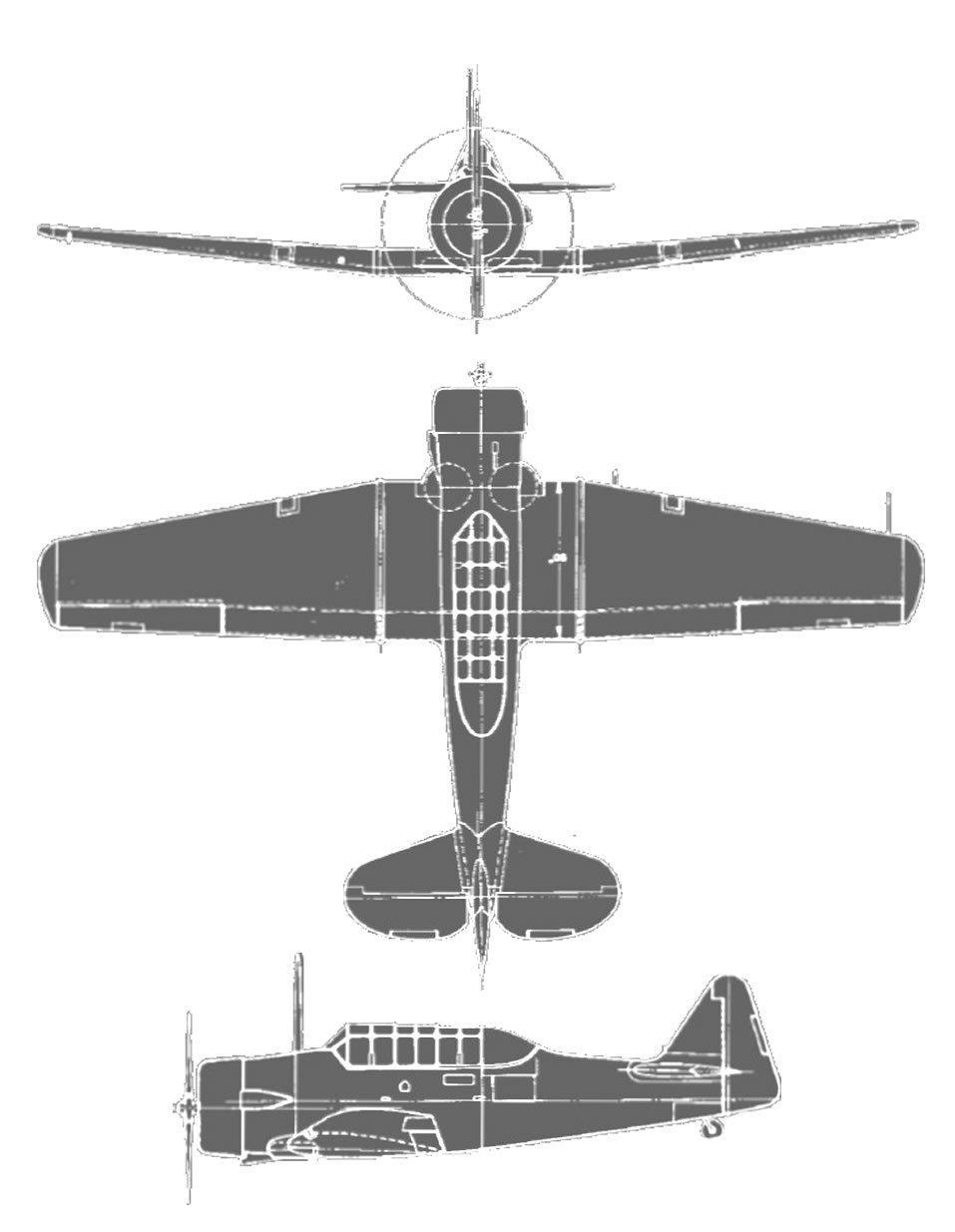
| AT-6 Specs | |
|---|---|
| Role | Trainer |
| Manufacturer | North American Aviation |
| Introduced | 1935 |
| Power | 1 × Pratt & Whitney R-1340-AN-1 Wasp radial engine, 600 hp |
| Length | 29 ft |
| Height | 11 ft 8 in |
| Wingspan | 42 ft |
| Range | 730 mi |
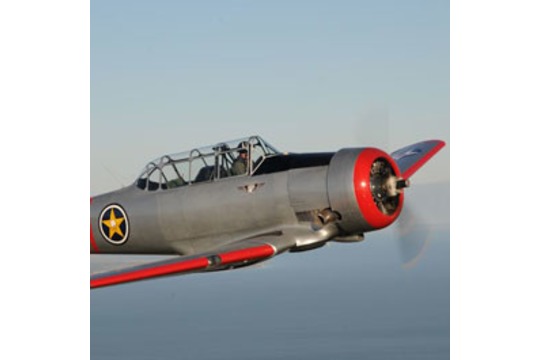
The North American Aviation AT-6 family of Advanced Trainers first entered service in 1938, and variants continued in service until recent times. The aircraft assigned to the Houston wing (affectionately referred to as “Ace”, as it carries the ‘Ace in the Hole’ insignia of the USAF 111th Fighter Squadron) is an AT-6A; about 1,800 were built. The naval version of the AT-6 is the SNJ; the approximate equivalent of the AT-6A is SNJ-3, and another 270 of these were built. In RAF and RCAF service, the AT-6 was known as the “Harvard”; most of these aircraft were built by Canadian Car and Foundry.
AT-6A’s were built at the original North American factory in Inglewood, California and at a new plant in Dallas, TX; the Dallas plant was the dominant source of the model. The AT-6 features a 600 HP Pratt & Whitney R-1340-49 radial engine, a variable-pitch propeller and retractable main landing gear. It also could be fitted with machine guns for use in gunnery training.
Later versions of the AT-6 (which was by then referred to simply as the T-6) continued in service after WWII. In addition to a training role, T-6’s were used as forward air control aircraft during the Korean War. They were often referred to as “Mosquitos” during this action. Several countries also used armed T-6’s as ground attack or counter-insurgency aircraft.
In 2001, the U.S. Defense Department recognized the legacy of the AT-6 Texan (often referred to a The Pilotmaker) by designating their new turboprop-powered trainer the T-6 Texan II.
The North American AT-6 Texan served as the United States’ primary advanced trainer during World War II, preparing pilots for high-performance combat aircraft. Designed by North American Aviation, it was a single-engine, low-wing monoplane equipped with a more powerful radial engine, retractable landing gear, and a variable-pitch propeller—features that introduced student pilots to the handling of frontline fighters. In the U.S. Army Air Corps and U.S. Army Air Force, it was called the AT-6; the U.S. Navy designated it as the SNJ, and British Commonwealth air forces knew it as the Harvard.
The AT-6 was vital to the Allied training program, serving as the last step before pilots transitioned to operational aircraft. It was used not only by the United States but also by the Royal Air Force and many Allied nations, remaining in service with some countries until the 1970s. A total of 15,495 units were produced, making it one of the most widespread advanced trainers of its time. Today, the T-6 remains a popular warbird, frequently appearing at airshows and often restored as replicas of Japanese aircraft such as the A6M Zero.