
Which Bomber Did the Most Damage in World War II
During World War II, the skies were filled with the largest, heaviest, and most technologically advanced bombers the world had ever seen. Aircraft like the B-17 Flying Fortress, B-24 Liberator, B-29 Superfortress, and Avro Lancaster didn’t just support the war effort—they helped define it.
But ask a deceptively simple question—which bomber did the most damage—and the answer quickly becomes complicated.
Because before you can answer it, you must decide what “damage” really means.
- Is it the total weight of bombs dropped?
- The destruction of industry?
- The number of lives lost?
- Or the ability to end a war?
Depending on how you define it, the answer changes, and so does the story.
The Case for the B-17: Relentless Pressure
If damage is measured by sustained destruction over time, the Boeing B-17 Flying Fortress makes a powerful case. Perhaps no aircraft is more closely associated with the strategic bombing campaign over Europe. Flying primarily with the Eighth Air Force, B-17s flew hundreds of thousands of sorties and dropped more than 640,000 tons of bombs—nearly half of all bombs dropped by the United States in the European Theater.
These weren’t isolated strikes. They were part of a grinding campaign to devastate Germany’s ability to wage war. The 1943 missions to Regensburg and Schweinfurt highlight both the effectiveness and the cost of that strategy. Bombers struck aircraft factories and ball-bearing plants—targets critical to Germany’s war industry. Production was significantly disrupted, and ball-bearing output dropped sharply in the months that followed. But the price was steep: roughly 60 bombers were lost, and hundreds of aircrews were killed. This was the reality of daylight precision bombing. It worked, but it demanded sacrifice.
Over time, repeated attacks on factories, rail yards, and infrastructure steadily weakened Germany’s industrial base. If damage is defined as sustained pressure that slowly chokes an enemy’s capacity to fight, the B-17 stands at the center of that effort.
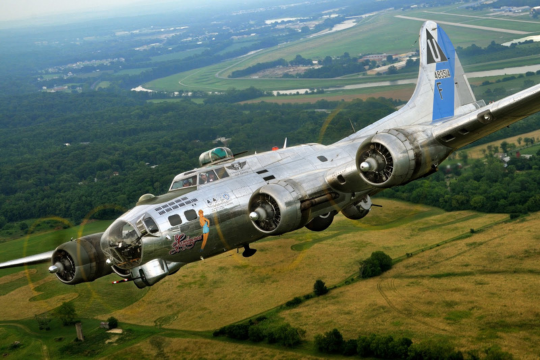
B-17 Sentimental Journey / Jay Beckman Photo |
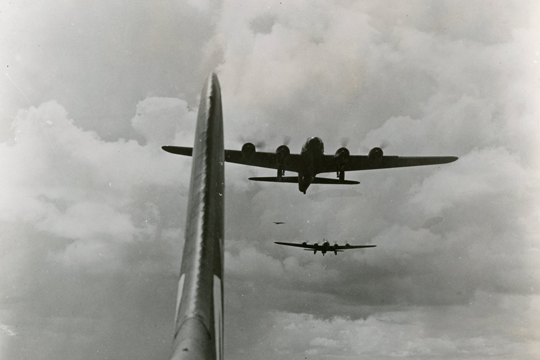
B-17s on a mission in 1942 / U.S. Air Force Photo |
The Case for the Lancaster: Area Bombing and Urban Destruction
While American doctrine emphasized daylight precision, the British took a different approach. Night after night, RAF Bomber Command sent aircraft such as the Avro Lancaster over German cities in large-scale area bombing campaigns. These missions were designed not only to hit specific factories but also to destroy entire urban centers—disrupting industry, infrastructure, and morale all at once.
The Lancaster was particularly well-suited for this role. It could carry heavy bomb loads, including specialized weapons such as the “Tallboy” and “Grand Slam,” capable of destroying hardened targets.
This approach peaked during operations such as the bombing of Dresden in February 1945. More than 12,000 Allied bombers—primarily Lancasters and B-17s—participated in the attack. The result was catastrophic. Firestorms engulfed the city, and an estimated 25,000 people were killed. The Dresden bombing remains one of the most controversial raids of the War.
If damage is measured in the destruction of cities and the human cost that follows, aircraft like the Lancaster—and the strategy they supported—cannot be ignored.
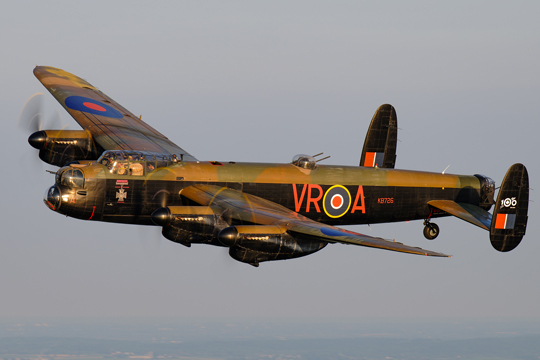
Canadian Warplane Heritage Museum's Lancaster bomber / Dylan Phelps Photo |
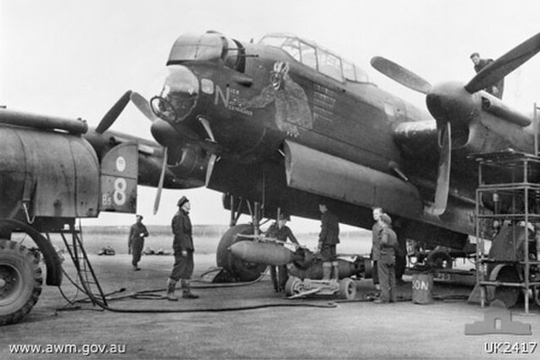
Lancaster bomber with No 463 Squadron / Australian War Memorial |
The Case for the B-29: A New Scale of Destruction
By the time the Boeing B-29 Superfortress entered combat in 1944, it represented a leap forward in aviation technology. Pressurized cabins, remote-controlled gun turrets, and long-range capability made it one of the most advanced aircraft of the War. It also delivered destruction on a scale the world had never seen.
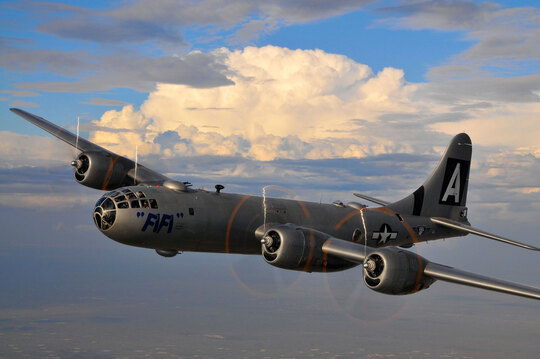
B-29 Superfortress in flight / Scott Slocum Photo |
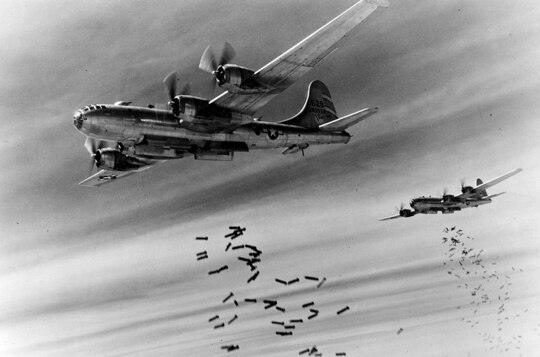
B-29s on bombing mission in Rangoon, Burma / U.S. Air Force Photo |
The Most Devastating Night
On the night of March 9–10, 1945, nearly 300 B-29s struck Tokyo in Operation Meetinghouse. Instead of high-altitude precision bombing, they dropped incendiaries designed to ignite the city below.
The results were staggering.
More than 100,000 people were killed in a single night. Fires consumed roughly 16 square miles of the city, making it one of the deadliest air raids in history, surpassing even the immediate destruction of either of the atomic bombings individually. If damage is defined as the most destruction inflicted in a single operation, the B-29’s incendiary campaign over Japan is difficult to surpass.
The War-Ender
Then came August 1945.
On August 6, the B-29 Enola Gay dropped an atomic bomb on Hiroshima. Three days later, another B-29, Bockscar, dropped a second bomb on Nagasaki. Together, the attacks killed an estimated 150,000 to 250,000 people, most of them civilians. These remain the only uses of nuclear weapons in warfare.
Their impact went beyond destruction. Within days, Japan announced its surrender.
If damage is measured not just in lives lost or cities destroyed, but in the ability to end a war, the B-29 stands alone. The Bigger Question: What Kind of Damage Matters?
By the final years of World War II, strategic bombing had evolved far beyond its early promises of precision. Weather, enemy defenses, and the realities of combat made consistent accuracy difficult. Industrial targets were often surrounded by civilian populations. Over time, the line between military and civilian objectives blurred.
Berlin was bombed hundreds of times. Entire sections of cities across Europe and Japan were reduced to rubble. The destruction was not only physical—it reshaped societies, economies, and lives on a massive scale.
This is where the debate becomes more than technical.
- Did sustained bombing campaigns shorten the war—or prolong suffering?
- Were attacks on cities a military necessity—or a moral compromise?
- Is the “most destructive” weapon the one that causes the most damage—or the one that changes the course of history?
There are no easy answers.
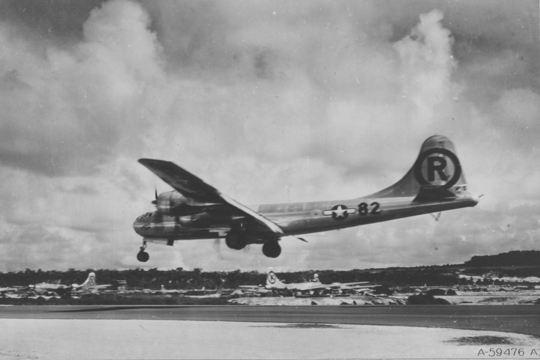
B-29 Enola Gay in the Mariana Islands / U.S. Air Force Photo |
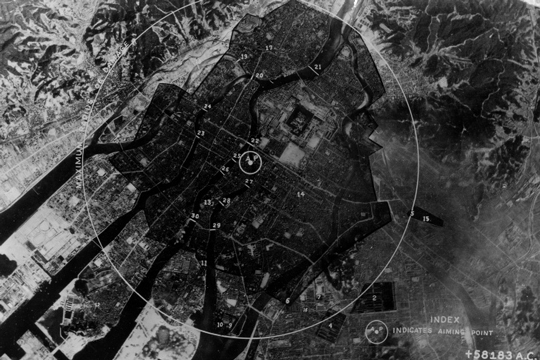
Strategic bombing devastation in Hiroshima / U.S. Air Force Photo |
So, What Bomber Did the Most Damage?
The answer depends entirely on how you define it.
• If it’s the sheer volume of bombs dropped and sustained industrial destruction, the B-17 makes a strong case.
• If it’s the deliberate destruction of cities, aircraft like the Lancaster represent a different kind of devastating impact.
• If it’s the most destruction in a single operation, the B-29’s firebombing of Tokyo stands out.
• And if it’s the ability to end the war itself, the B-29’s atomic missions are supreme.
In the end, there is no single answer—only perspectives.
What remains clear is that these aircraft, and the strategies behind them, helped shape the outcome of the most destructive conflict in human history.
And the debate over their impact is far from over.
Sources
- Richard Overy. The Bombing War: Europe 1939–1945. Penguin Books, 2013.
- United States Strategic Bombing Survey. Summary Report (European War). 1945.
- United States Strategic Bombing Survey. Summary Report (Pacific War). 1946.
- Donald L. Miller. Masters of the Air. Simon & Schuster, 2006.
- Max Hastings. Bomber Command. Pan Books, 1979.
- Kenneth P. Werrell. Blankets of Fire. Smithsonian Institution Press, 1996.
- National WWII Museum. “Atomic Bombing of Hiroshima and Nagasaki.”
Like stories like these?

About the Historian
Annie Flodin is an aviation journalist, photographer, and historian based in Fort Worth, Texas. She has worked in the aerospace industry for nearly a decade, including several years as a corporate historian for The Boeing Company. In that role, she collaborated with the Commemorative Air Force on a variety of projects focused on preserving and sharing aviation history. She is currently pursuing her Private Pilot License and hopes to one day fly with the CAF.