
T-28 High Sky Wing
Description:
Base:
KMAF, Midland, TX
Website:
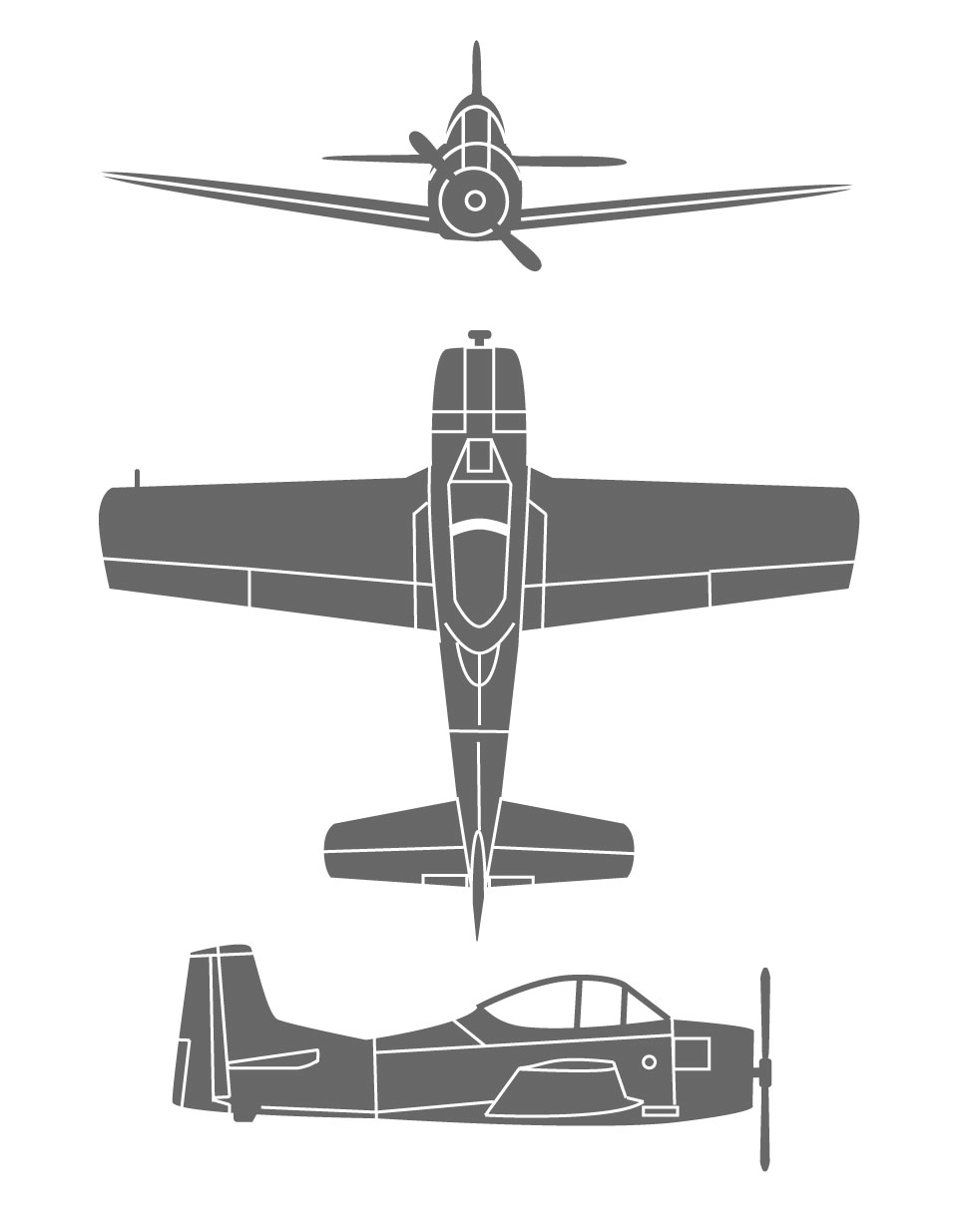
| T-28 Specs | |
|---|---|
| Role | Trainer |
| Manufacturer | North American Aviation |
| Introduced | 1949 |
| Produced | 1950-1957 |
| Power | Wright R-1300 of 800 hp |
| Length | 32 ft |
| Height | 12 ft 8 in |
| Wingspan | 40 ft 7 in |
| Range | 1,000 miles |
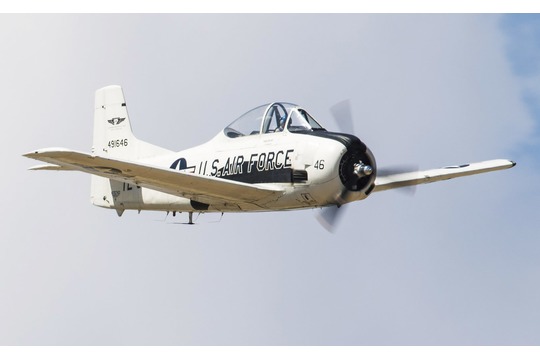
The North American T-28 Trojan first flew in 1949 as the NA-159/XT-28, developed to replace the North American T-6 Texan and train pilots for the jet age. A single-engine aircraft built for the early Cold War, it served with 28 countries across nine variants. The U.S. Air Force operated the T-28 into the early 1960s, while the Navy, Marine Corps, and Coast Guard continued flying it into the early 1980s.
Though designed as a trainer, the T-28 also saw combat in Southeast Asia. It was the first fixed-wing attack aircraft lost in South Vietnam, and in a lesser-known twist, became the first fighter used by the North Vietnamese Air Force after a Laotian pilot defected with one in 1963.
The T-28A was powered by an 800-horsepower engine, with later models increasing to 1,425 horsepower. Its military service ended in 1984 at NAS Corpus Christi, when it was replaced by the Beechcraft T-34C Turbo Mentor. Today, the T-28 stands as a symbol of the transition from World War II training to the jet age.
The North American T-28 Trojan first flew in 1949 as the NA-159/XT-28, developed to replace the North American T-6 Texan and train pilots for the jet age. A single-engine aircraft built for the early Cold War, it served with 28 countries across nine variants. The U.S. Air Force operated the T-28 into the early 1960s, while the Navy, Marine Corps, and Coast Guard continued flying it into the early 1980s.
Though designed as a trainer, the T-28 also saw combat in Southeast Asia. It was the first fixed-wing attack aircraft lost in South Vietnam, and in a lesser-known twist, became the first fighter used by the North Vietnamese Air Force after a Laotian pilot defected with one in 1963.
The T-28A was powered by an 800-horsepower engine, with later models increasing to 1,425 horsepower. Its military service ended in 1984 at NAS Corpus Christi, when it was replaced by the Beechcraft T-34C Turbo Mentor. Today, the T-28 stands as a symbol of the transition from World War II training to the jet age.